


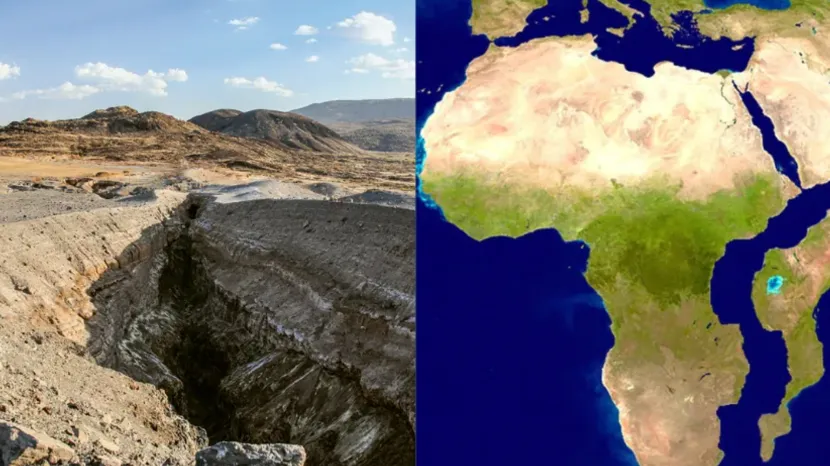
Geologists have long studied the East African Rift System, but recent findings highlight the dramatic potential of this tectonic activity: the African continent is slowly splitting apart, and over millions of years, this process could eventually give birth to a brand-new ocean.
The East African Rift is a vast tectonic boundary stretching from the Afar region in northeastern Ethiopia down through Mozambique. Here, the African Plate is gradually pulling away from the Somali Plate due to immense geological forces beneath the Earth\'s surface. This slow divergence—measuring only a few millimeters to centimeters per year—may not be noticeable on a human timescale, but it represents a monumental shift in Earth\'s geological landscape.
Experts explain that the rifting process has already led to the formation of deep cracks in the Earth\'s crust, active volcanoes, and earthquakes along the fault lines. In some places, like the Afar Triangle, the land is already dropping and thinning. Eventually, this area could become submerged by seawater, forming an ocean that would split East Africa from the rest of the continent, much like how the Red Sea and the Gulf of Aden were formed.
While this transformation will likely take between 5 to 10 million years, the evidence suggests that the process is well underway. One notable example occurred in 2005, when a massive crack measuring 60 kilometers long suddenly opened up in Ethiopia. Such events provide rare, visible proof of continental rifting in action.
Scientists are particularly interested in this region because it provides a real-time view of how continents break apart—a phenomenon that shaped the current layout of Earth\'s continents and oceans. The formation of a new ocean would have profound implications for biodiversity, climate, and future human settlement patterns in the region.
Though the full transformation lies in the distant future, the idea that a new ocean could one day emerge in East Africa offers a fascinating glimpse into the planet’s ever-changing geology.
Suhuyini
Okay
Marena25
Alright
Samuel Boafoh
million years