


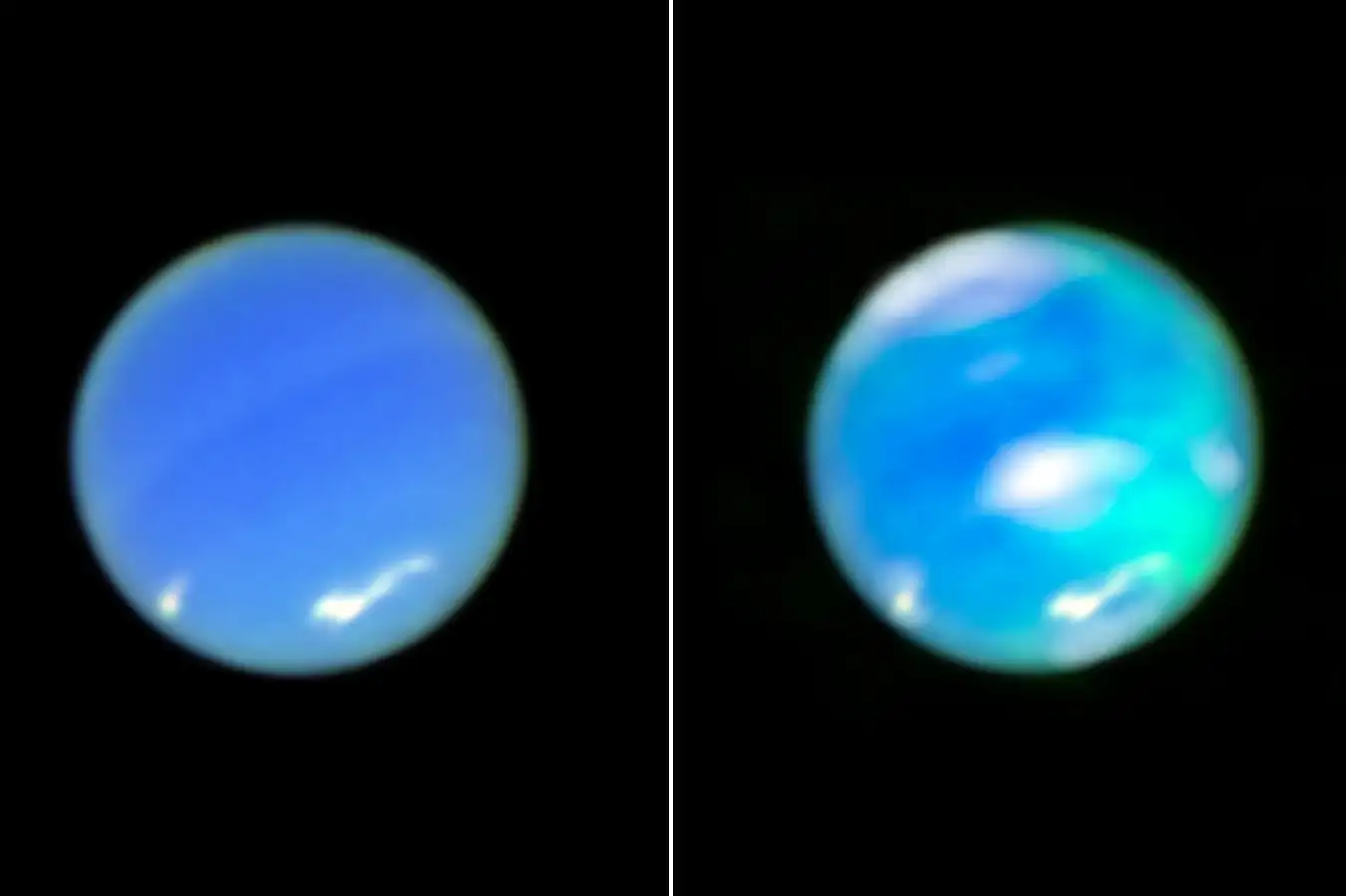
On March 26, 2025, astronomers confirmed the presence of aurorae on Neptune for the first time in scientific history, marking a significant milestone in planetary science. The breakthrough was achieved through a collaborative effort, combining visible-light observations from the Hubble Space Telescope with near-infrared imaging from the James Webb Space Telescope (JWST).
Aurorae—commonly known as the northern and southern lights on Earth—occur when charged particles from the solar wind interact with a planet\'s magnetic field and atmosphere, producing glowing patterns of light near the poles. While aurorae have been observed on several planets in the solar system, including Jupiter, Saturn, and even Uranus, this is the first time they have been definitively observed on Neptune.
The joint data from Hubble and JWST revealed distinct emissions in Neptune\'s polar regions, consistent with auroral activity. These emissions align with fluctuations in the planet’s magnetic field and changes in solar wind intensity, confirming the natural light show was driven by the same underlying processes as on other magnetically active planets.
This discovery is crucial because Neptune remains one of the least-understood planets in the solar system. By studying its aurorae, scientists gain valuable information about Neptune\'s magnetic field structure, atmospheric composition, and internal dynamics. Unlike Earth\'s relatively aligned magnetic and rotational axes, Neptune\'s magnetic field is highly tilted and offset, making its aurorae especially complex and scientifically valuable.
The confirmation of aurorae on Neptune not only enhances our understanding of the outer planets but also provides a benchmark for studying exoplanets with similar compositions and magnetic activity. It underscores the power of combining space telescopes like Hubble and JWST to reveal secrets hidden in the distant reaches of our solar system.
Walker
Waoo
KHANDY
Nice
Marena25
Like it
hossman
Wow
Suhuyini
Okay
Happy
Nice
Successventuresgh
Happy
Razak1
Hmmm