


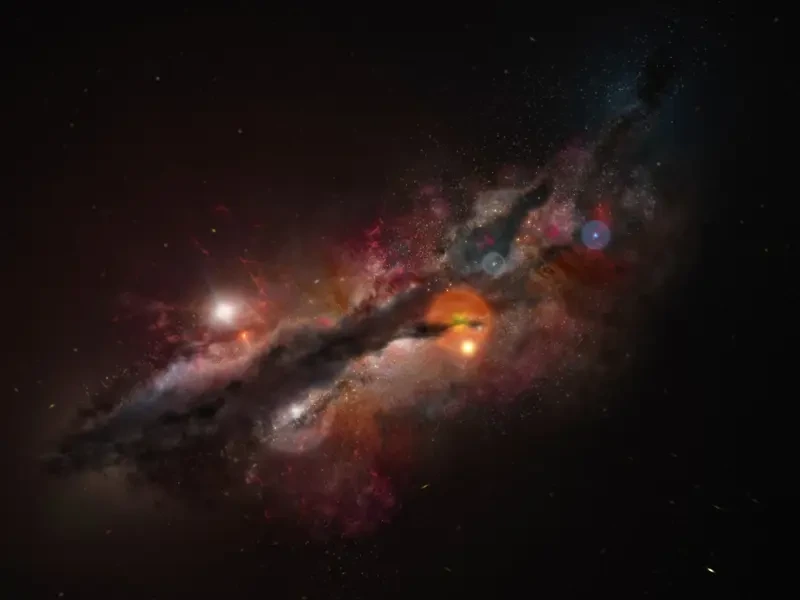
On March 20, 2025, astronomers made a remarkable discovery by detecting oxygen in the galaxy JADES-GS-z14-0, which lies an astonishing 13.4 billion light-years from Earth. This galaxy, identified by the James Webb Space Telescope (JWST), is currently the most distant known galaxy ever observed, dating back to just 300 million years after the Big Bang.
The detection of oxygen in such an early cosmic era is a breakthrough in understanding how elements formed in the young universe. Oxygen, a heavier element, is forged in the cores of massive stars and released into space during supernova explosions. Its presence in JADES-GS-z14-0 indicates that multiple generations of stars had already lived and died within a few hundred million years after the universe began, a much faster timeline for stellar evolution than previously assumed.
The discovery was made possible by analyzing the infrared spectra from JWST, which revealed specific emission lines associated with ionized oxygen. These spectral fingerprints confirm not only the presence of oxygen but also provide insight into the chemical composition, star formation rate, and temperature of the galaxy.
Astrophysicists say this observation reshapes our understanding of the early chemical enrichment of galaxies, suggesting that the processes of star formation and element synthesis were already well underway at an incredibly early stage of cosmic history.
This finding adds to the growing list of discoveries made by JWST, reinforcing its role as a revolutionary tool for peering into the early universe and helping scientists piece together the timeline of cosmic evolution.
KHANDY
Ok
Marena25
?
hossman
Oxygen in space
Suhuyini
Okay
Walker
Okay
Happy
New discovery