


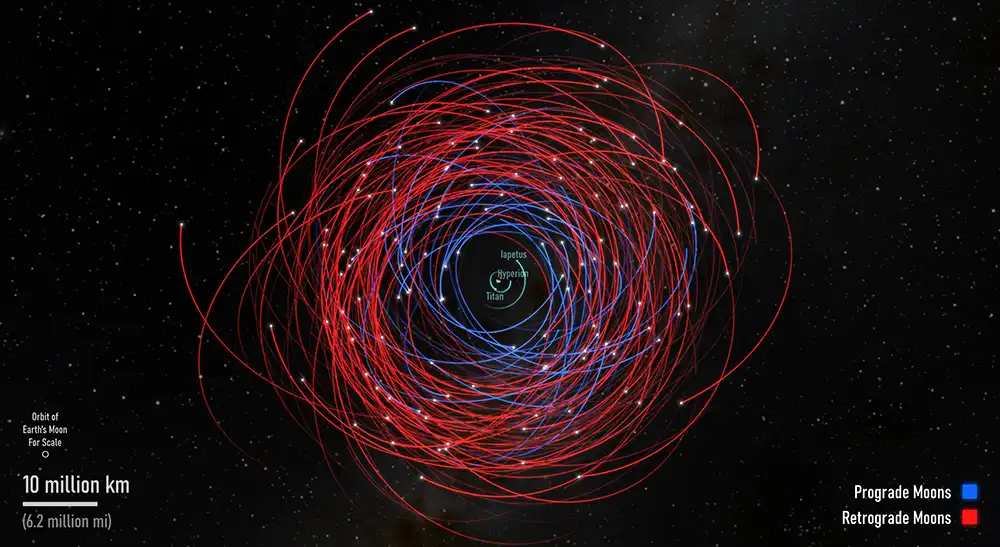
On March 11, 2025, astronomers announced the discovery of 128 new moons orbiting Saturn, a major leap in planetary science that elevates Saturn’s total number of confirmed natural satellites to 274—the most of any planet in the solar system. The breakthrough was made possible by deep-sky observations using the Canada-France-Hawaii Telescope (CFHT) located on Mauna Kea, Hawaii.
The new moons, many of which are small and irregularly shaped, were detected through a technique known as \"shift-and-stack,\" which allows researchers to track faint objects over time by aligning images taken across multiple nights. These moons likely belong to a class of irregular satellites, believed to be remnants of larger celestial bodies that were captured by Saturn’s gravitational pull and later shattered by collisions.
The discovery offers new insights into the evolution of Saturn’s ring system, the gravitational interactions among its moons, and the history of the outer solar system. Scientists believe that studying the orbits, compositions, and groupings of these moons could reveal more about the processes that shaped the early solar system.
This landmark achievement also reinforces Saturn\'s title as the \"moon king\" of the solar system, surpassing Jupiter, which had previously reclaimed the lead in satellite count in 2023.
Further analysis and naming processes for these new moons are underway, and astronomers anticipate that future advancements in telescopic technology could unveil even more celestial companions around the gas giant.
Marena25
Okay
hossman
I taught we only have one moon in the galaxy
Suhuyini
Okay
KHANDY
Okay
Walker
Amazing
Happy
Interesting
Polina
Okay