


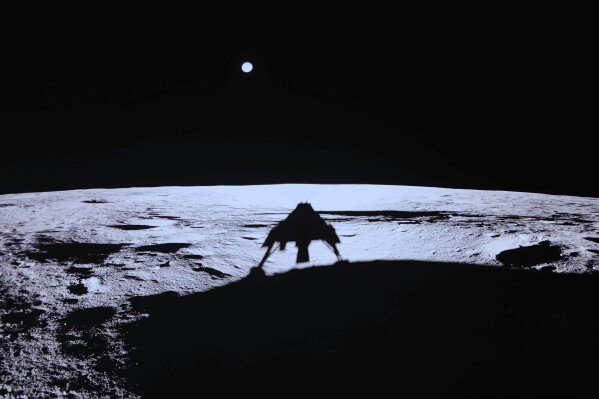
On March 2, 2025, Firefly Aerospace etched its name into the annals of space history by successfully completing a lunar landing as part of its Blue Ghost Mission 1. The mission, developed under NASA’s Commercial Lunar Payload Services (CLPS) program, represents a landmark achievement in public-private collaboration aimed at advancing lunar science and exploration.
The Blue Ghost lander touched down on Mare Crisium, a lunar basin located on the near side of the Moon, with remarkable precision. Its primary objective was to deliver multiple scientific payloads developed by NASA and its partners. These instruments are designed to study the lunar regolith—the layer of loose, fragmented material covering the Moon’s surface—as well as to analyze the interaction between the solar wind and Earth\'s magnetic field, particularly in a region largely devoid of a natural magnetic shield.
This success marks a significant milestone not only for Firefly Aerospace but also for the broader field of commercial space exploration. It demonstrates the increasing capability of private companies to conduct complex space missions that were once the sole domain of government agencies. With Blue Ghost Mission 1, Firefly joins a short list of commercial entities that have managed to land on the Moon, proving its technical maturity and operational reliability.
NASA Administrator Bill Nelson praised the accomplishment, stating that it reflects the growing role of the private sector in supporting America’s return to the Moon and future ambitions for deep space exploration, including crewed missions to Mars.
Beyond its scientific goals, the mission also tested several new technologies, such as advanced thermal shielding, power systems, and autonomous landing capabilities. These innovations will inform future missions and help build the foundation for a sustainable human presence on the Moon.
Firefly has already announced plans for Blue Ghost Mission 2, scheduled for 2026, which aims to deliver even more payloads and expand operational capabilities. The success of Mission 1 underscores a transformative shift in spaceflight—where entrepreneurial vision and scientific ambition are propelling humanity further into the cosmos.
Walker
Nice
hossman
ok
Happy
Nice
KHANDY
Good
Marena25
Good
Suhuyini
Okay