


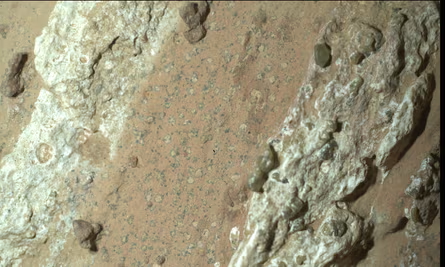
In a groundbreaking development that could significantly reshape our understanding of life beyond Earth, NASA’s Perseverance rover has uncovered what scientists believe to be fossilized remnants of ancient microbial life on Mars. The discovery was made as the rover investigated sedimentary rock formations in Jezero Crater—a site that once housed a vast lake billions of years ago and has long been considered one of the most promising locations to search for past life on the Red Planet. Using a suite of advanced onboard instruments, Perseverance collected and analyzed rock samples that revealed the presence of organic molecules arranged in highly specific, structured patterns.
According to findings published today in the journal Science, these patterns bear a striking resemblance to microscopic fossil structures known to be produced by microbial life on Earth. The structures measure approximately 1 to 2 micrometers in length, comparable to nanobacteria found in ancient terrestrial environments. What sets this discovery apart from previous detections of organic matter on Mars is the organization and complexity of the molecules—features that suggest a biological, rather than geological, origin.
Researchers observed branching, filament-like formations within the rock samples, a characteristic hallmark of microbial mats and biofilms found in Earth’s early sedimentary records. These fossil-like imprints are remarkably similar to stromatolites—layered structures created by colonies of microorganisms—offering a potential analog for interpreting Martian biosignatures. Additionally, spectroscopic analysis confirmed the presence of complex carbon-based compounds, including polycyclic aromatic hydrocarbons and amino acid precursors, which are typically associated with biological processes.
Dr. Elena Martinez, a lead astrobiologist on the Perseverance science team, emphasized the importance of the find: “While we cannot yet say definitively that these are fossils of Martian microbes, the morphological and chemical evidence points toward a once-living biological origin. This could be the closest we’ve come to confirming that life existed elsewhere in the solar system.”
NASA is now prioritizing these rock samples for its upcoming Mars Sample Return mission, which aims to bring them back to Earth for more detailed laboratory analysis. If verified, the implications would be profound—not only confirming that life once existed on another planet but also suggesting that life could emerge in other environments beyond Earth. This discovery marks a historic moment in planetary science and opens up new frontiers in the search for extraterrestrial life.
hossman
sure
Caramel
Good
KHANDY
Sure
Suhuyini
Okay
Successventuresgh
Really
Walker
Super
Marena25
Good